This Article

In this 7-minute article we explore the concept of archetypes in general and brand archetypes in particular. 

Subjects covered include;

  • The history of archetypes
  • The 12 brand archetypes – theory and practice
  • How to use brand archetypes
  • How to identify the most suitable archetype for your own brand
  • How to ensure that your preferred archetype is the right one for your target audience

A quick history of archetypes

Brand archetypes have their roots in psychology. 

Sigmund Freud kicked things off, with his psychcoanalytic theory of personality, in which he identified the unconscious mind as the repository for feelings, thoughts, perceptions and memories that lie outside the conscious mind.  Freud believed that even though we are not aware of them, the contents of this repository exert considerable influence over the attitudes, decisions and behaviours of us all.  

Screenshot-2021-04-29-at-13.48.07 Brand archetypes – bonding with your consumer
Sigmund Freud

It was the Swiss psychiatrist and psychoanalyst Carl Jung who then advanced Freud’s thinking, with his theory of the existence of the collective unconscious.

Jung believed the collective unconscious contains a number of mythical archetypes (archetype meaning original pattern in ancient Greek), each reflecting a bundle of basic emotions, values, behaviours and ideas that were first experienced by our earliest ancestors and then passed down to us, as a sort of genetic inheritance. 

Jung believed that, as a result of this inheritance, we are all hardwired to recognise these archetypes subconsciously, and are instinctively drawn to the one(s) that best suit our own emotional disposition and needs.  

From archetypes to brand archetypes

In 2001, authors Margaret Mark and Carol S. Pearson expanded on Jung’s work in their book “The Hero and the Outlaw”, which was aimed at the marketing community.  In it they explored how archetypes can be used to position brands in ways that fundamentally alter and enhance the consumers’ relationship with them.

The book identified 12 archetypes which between them reflect a spectrum of basic consumer needs and motivations.  They are; The Innocent, Everyman, Hero, Outlaw, Explorer, Creator, Ruler, Magician, Lover, Caregiver, Jester, and Sage.

The Brand Archetype Wheel

The 12 archetypes reflect 4 underlying ‘orientations’ or need states that humans are seeking to attain, as follows;

  • Structure Those motivated to create structure in the world
  • Freedom; Those wishing to provide emotional or intellectual liberty 
  • Ego; Those wishing to challenge the status quo and leave their mark
  • Social; Those motivated to connect with others

The relationship between the 4 orientations and the 12 brand archetypes can be clearly seen in the Brand Archetype Wheel; 

The Brand Archetype Wheel – reproduced by courtesy of Iconic Fox – (https://www.iconicfox.com.au

The overarching case for brand archetypes

The theory is actually a simple one; if a brand is able to identify the archetype that a) best reflects its personality and b) aligns most closely with the emotional needs of its target audience, then it has the opportunity to create a brand positioning capable of making a fundamental connection with that consumer group. 

But brand archetypes are far more than just brand positioning templates.  Their detail can be used to help craft the brand’s value proposition, values, essence, purpose and tone of voice.    

The 12 brand archetypes in detail

1.     The Everyman Archetype

Additional Everyman brands include Tesco and Volkswagen.  Consider this Volkswagen brand and the extent to which it aligns with The Everyman archetype; 

The ad reflects common Everyman attributes (e.g. belonging, solid virtues, being down to earth, lack of pretence) in a way that is both highly insightful and creative.  These characteristics have been common across VW’s advertising over many years.  

2.  The Creator Archetype

Infographic courtesy of Iconic Fox

The Apple brand and it’s Think Differently strategy fits perfectly with the Creator archetype.

Apple has been hugely successful in positioning itself and its products as individual,  authentic, and creative – a credible alternative to the mainstream.  

This positioning has enabled it to made a deep, emotional connection with members its fanatically loyal customer base, for whom the brand acts as a means of self-expression and an extension of their own personalities.

Apple perpetuates this positioning in its ongoing product development and marketing, being careful to ensure that every new product launch experience has a ground-breaking feel it; the thinnest, the most powerful, the most aesthetically appealing……. 

The remaining brand archetypes are as follows;

3. The Innocent Archetype

Innocent brands are honest, pure, trustworthy and wholesome.  They convey optimism and steadfastness. Innocent brands include Dove, Disney and Innocent smoothies.  

The Innocent brand doesn’t make the list because of its name, but because, since its inception, it has combined the purity of its products with the playfulness in its communications.

4. The Hero Archetype

Hero brands are bold, inspiring, reliable and aspirational. They challenge rather than nurture and act as the benchmark for their competitors to follow. Example brands include: BMW, Duracell and Nike, with its “Just Do It” Logo, encouraging its audience to be the best they can be.

5. The Rebel Archetype

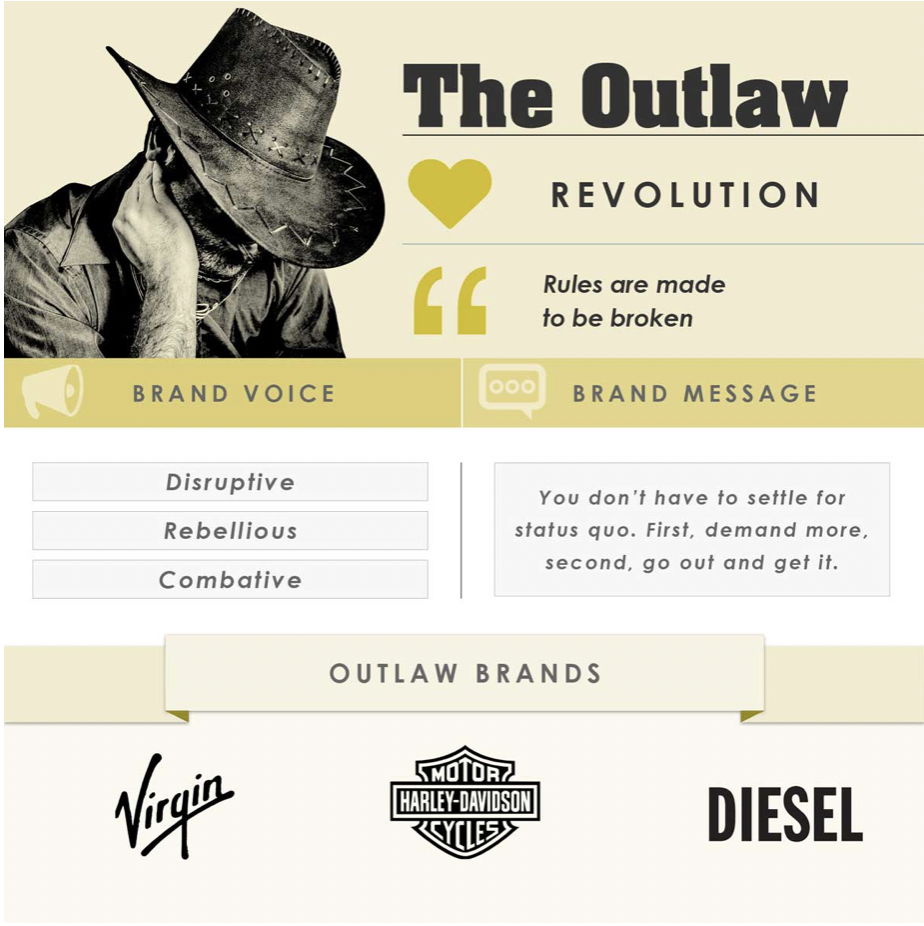
Rebel brands adopt an anti-establishment stance and stand for freedom from convention and mediocrity. For those who want to make a statement and be seen to stand slightly apart.   Brands include Virgin, Harley-Davidson and Brew Dog, the craft beer brand taking on the mainstream beers with its feisty, punk attitude. 

6. The Explorer Archetype

Explorer brands stand for discovery, thrill seeking and preservation, leading to self-enlightenment. Example of brands that reflect this brand archetype include Land Rover and Patagonia. 

7. The Ruler Archetype

Ruler brands stand for order amongst chaos.  They regard themselves as a cut above.  .  Ruler brands are calm, understated, powerful, organised and consistent.  They enjoy leadership and even control.  Brands that reflect the Ruler archetype include Mercedes-Benz and Rolex.

8. The Magician Archetype

Magician brands are spiritual, focussed on turning ordinary in to special and dreams in to reality. Brands reflecting the Magician archetype include Disney and Coca Cola.  Coke has long-produced magical ads such ‘Holidays are Coming’ and the hilltop “I’d like to buy the world a coke’ execution, which showcase the brand’s ability to spread happiness and joy everywhere.

9. The Lover Archetype

Lover brands are sensual and passionate, determined to create and celebrate truly special moments.  Example brands include: Victoria’s Secret, Chanel, Haagen Dazs and Dior.

10. The Caregiver Archetype

Caregiver brands are focussed on protecting and caring for others. They are established, generous, nurturing, strong and unquestioning.     Examples of this archetype include Dettol, Johnson & Johnson, the Red Cross and British Airways.

11. The Jester Archetype

Jester brands are joyful, mischievous and irreverent, determined to make the day brighter.  Their raison d’être is to spread happiness and good humour.  Example brands include: Ben & Jerry’s and Snickers.

12. The Sage Archetype

Sage brands perform the role of advisors and mentors, there to impart their wisdom and create understanding. Sage brands are constantly looking for truth. Example brands include: BBC and Google.

How do you identify the best archetype for your own brand?

Whether your brand is going to adopt one of the 12 brand archetypes or another sort of brand persona that mixes and matches different personality traits, the place to start is not with your own brand, but those of the competition. 

If you map your competitor brands according to the personality of each, you will find areas of your map where there is considerable brand overlap.  These are ‘obvious’ positioning territories, but ones that are already fiercely contested, meaning that the brands occupying them are effectively cancelling each other out.  

The positioning territory you seek should be one that;

  • Your brand can own.  That means that it is likely to be territory that is largely unpopulated by other brands, or is populated unconvincingly at present
  • Is a natural fit for the way you see your brand – or would like it to be seen
  • Can support the price and the usage occasions / frequency you project for your brand 

There are several workshop techniques you can use to identify the most fertile positioning territory for your brand.  Once identified, it will enable you to rule in / out the brand archetypes that could be applied. 

Having used the territory mapping exercise to identify potential archetypes for your brand, your archetype candidate(s) in the context of your target audience, in order to determine whether the archetype(s) you are considering will be capable of establishing the sort of emotional connection that is required.

Qualitative market research is required here to first identify the defining personality traits, emotional needs and aspirations of your target audience and then assess archetype suitability and appeal within the context of these.  

Having assessed your archetype options in relation to your brand, your competitors and your customers, you are now in a position to select the one that will be most capable of differentiating your brand whilst resonating strongly with your customers. 

Brandspeak

Brandspeak specialises in brand market research and consulting for B2B and B2C brands.  To understand more about the options for your brand please contact us at enquiries@brandspeak.co.uk

Introduction

This 5-minute article provides a clear definition of brand purpose, as well as explaining its importance in contemporary brand development. The article reveals how any organisation can develop its own brand purpose statement, and the issues that will determine its success – or failure.

Context

Quite simply, brand differentiation is everything.  An undifferentiated brand doesn’t stand out amongst its competitors and doesn’t come readily to mind.  

The best way to create real differentiation is through innovation.  This can be at the product or service level (think Dyson) but it can also be in relation to the brand’s channel or distribution strategy (think Uber) or the nature of the customer experience that is provided (think Ikea).

And differentiation doesn’t have to rely on physical innovation at all. Marketers create brand differentiation and stand-out via the creative articulation of the brand’s value proposition and the creativity of its advertising and marketing communications.

During the last 10 years, marketers have had another means of differentiating the brand – through brand purpose.

What is brand purpose?

A brand’s purpose is its overarching raison d’être – the ‘higher purpose’ that acts as its reason to get up and go to work in the morning.  Typically, it is linked to a social or environmental issue that has relevance far beyond the brand’s narrow target audience and commercial focus.  

At this point in any article focussing on brand purpose, it is often Unilever’s Dove body care brand purpose that is used as the example.  

Dove declares its brand purpose as; 

Discovering the value of ‘real’ beauty and improving self-esteem worldwide

Dove’s aim is to help change society’s highly damaging view of what constitutes beauty, thereby helping to address the self-esteem of millions of people globally.

The reason that the Dove example is cited so often is that it isn’t just paying lip service so that it can jump on the brand purpose bandwagon.  Dove uses its advertising to challenge stereo-typical views of beauty in a way that is confrontational and by doing so it forces consumers to challenge their own pre-conceptions. 

The brand has also created numerous campaigns designed to help women boost their self-esteem.

In addition, Dove has partnered with Getty Images to build a photo library of over 11,000 images of individuals who identify as female or non-binary.  The initiative is known as Project #ShowUs and the images are available to media companies and advertisers to use in their campaigns.  So far, over 3,000 of the images have been licenced.  

Of course, one could argue that this is no more than a self-serving marketing strategy.  Well, yes, it is self-serving but, on the other hand, which commercial enterprise is going to pursue a marketing strategy that actively undermines its brand!  

What Dove has managed to do very successfully is identify a brand purpose which enables it to pursue its own commercial agenda whilst at the same publicising and helping to address a social issue of global significance. 

But why is having a brand purpose so important today?

Well, the cynical view is that it’s important because if Brand A promotes a brand purpose, brand B must promote one too, or suffer by comparison.

In reality though, it’s because today’s consumers have simply moved on.  Gen Z and Millennials in particular expect brand authenticity and they want the brands they buy to reflect their priorities.  Moreover, empty words are no longer enough – they also expect their brands to back their words up with actions.  

And it’s a trend that isn’t going to change any time soon. 

According to a global, 2018 survey by Accenture, 66% of consumers think transparency is one of the most attractive qualities in a brand.  This includes transparency about where the brand sources its materials and what it cares about beyond profit.  

In the same survey it was also reported that 62% of consumers want companies to stand up for the issues they are passionate about.

In addition;

  • A 2019 survey by Stackla revealed that 86% of consumers (particularly Gen Z and Millennials) regard brand authenticity as a key factor when deciding which brands to patronise.  
  • Edelman’s global, 2017 study found that 50% of consumers worldwide consider themselves to be belief-driven, whilst 67% bought a brand for the first time because they agreed with the position it had taken regarding a controversial topic

The brand purpose agenda isn’t just about consumers, however. Brand purpose creates a enables the brand to create a more emotional connection with the consumer, based on common values.  Those values, in turn, lead to a greater consumer loyalty.

OK! But what about the brand vision and mission?

So, if brand purpose is the new, must-have brand architecture accessory, where does that leave brand visionand mission

Brand purpose is outward-looking,  socially responsible and relevant – totally in step with consumer thinking and behaviour. 

By contrast, brand vision and mission are inward-looking and self-serving, far more focused on the trajectory of the brand rather than the society from which it makes its profit.   

As a result, both can be considered increasingly anachronistic within the current environment. 

BTW – They have also been responsible for confusing a whole generation of marketers, many of whom understandably find it difficult to differentiate between the two!   

How do you identify your brand purpose?

Brandspeak has helped a number of organisations identify and shape their brand purpose.  Through that work we have identified the following, brand purpose ‘must-haves’;

  • The brand purpose that is selected must be of equal importance to the brand and the target audience.  
  • Consumers are suspicious of brand motivations.  Therefore, any brand wishing to  publicise its brand purpose must be prepared to back up its words with actions, or risk alienating the very consumers it is looking to attract
  • Consumers are only too willing to interpret brand vagueness as insincerity.  Again, action is needed to clarify brand purpose words 
  • Brand purpose must be more than skin-deep.  Consumers want to be convinced that the whole organisation is on-board – not just the marketing and management layers.

Other brand purpose examples

The Bodyshop

The Bodyshop’s brand purpose statement is as follows; 

To become the world’s most ethical and truly sustainable business.

Its message takes centre stage in its advertising; 

The company backs up its brand purpose words with action.  Along with brands like Ben & Jerrys and Patagonia the The Bodyshop is a certified B Corp organisation.  B Corps are businesses committed to pursuing the highest social and environmental standards.

Patagonia

Patagonia’s brand purpose is; 

To build the best product, cause no unnecessary harm, use business to inspire and implement solutions to the environmental crisis.

The company actively delivers on its brand purpose in numerous ways, including; 

  • Switching to 100% organically grown and ethically sourced cotton
  • Undertaking environmental educational events
  • Supporting of grassroots environmental efforts
  • Reducing corporate waste and pollution

Lego

Lego’s brand purpose is; 

 “To inspire and develop the builders of tomorrow”

The emphasis is on using the power of play as a conduit for education, learning and wellbeing.  

Through the Lego Foundation, Lego has teamed up with Sesame Street and organisations working with Syrian and Rohingya refugees. The aim is to create play-based learning programmes for children up to the age of 6 in Lebanon, Jordan, Iraq and Bangladesh.

Conclusion

The growing importance of brand purpose underlines the continuing power shift from brand to consumer.  The days of brands telling consumers what to think and how to behave are over (at least for the time-being!). 

Increasingly it is the consumer that has the upper hand in determining what their favourite brands should stand for.  And as consumers continue to become more engaged with the social, environmental and even political challenges affecting us all we can expect brands to become ever more purpose-led, 

Brandspeak

If you would research to help identify and refine your own brand purpose statement, or to understand how best to bring it to life in terms of what your organisation says and does, please contact Brandspeak at enquiries@brandspeak.co.uk or on +44 (0)203 858 0052.
1. Introduction

When it comes to briefing a market research agency, the quality of the information you provide is crucial. Quite simply, the better the information, the better the proposal – and the quicker you will receive it.

This article has been compiled for anyone who is unsure what information is required in order to obtain a great market research proposal.

In it we outline the sections of the ‘ideal’ market research brief, as well as explaining within each section what information is most helpful – and why.

And don’t worry if you can’t provide all the information suggested. Whatever you can provide will act as a starting point for a conversation during which the agency.

At the end of this article we’ve also providing a link to a downloadable and editable market research agency briefing form that has been designed to collect the information outlined in this article.

2. Requirement overview

Here you should just lay out in a sentence what the research will be about and where it needs to take place. For example;

  • Qualitative research to explore a new push chair concept with UK mums
  • Survey of SME purchase decision-makers regarding IT support contracts in USA, UK, Germany and France

3.    Your company and its offer

Next, provide your agency with some useful detail about your company. For example; whether you are a B2C or B2B organisation, your location (especially if outside UK), your products or services, channels to market, customer base and key competitors.

In fact, anything that provides context that will help the agency understand you and your research needs better.

A link to your website will also be helpful.

4.    The business requirement

Before explaining your specific market research needs, it is very helpful for the research agency to understand the wider business context of the research; e.g. the business circumstances that have led to the need for this research and how the research findings will be used.

This information helps the research agency to ensure that the research approach and deliverables it recommends will not only meet your research needs, but will also be suitable more broadly.

5.    The market research objectives

This is probably the most important part of the research brief so it’s worth taking time over!

It’s where you provide a list of the project objectives and / or the questions that you need the research to answer.  Bullet points are fine and the more detail here the better!

The research agency will use the objectives you provide to identify the best research approach and develop the individual questions that it will ask in the research.

The agency will also use your stated objectives to identify if/ where it thinks there are gaps in the insights you are seeking, or whether it can usefully suggest additional objectives that could provide added value for no additional cost.

6.     Preferred approach

If you have any thoughts or expectations regarding the research methodology (e.g. quantitative / online survey or combined), its always good to include these.

It’s helpful for the research agency to understand your methodological expectations or preferences at this point, because there is often more than one way to approach a project.

And if the research agency doesn’t agree with your preferred approach, it will (tactfully!) explain why.

7.    Research recruitment profile

In this section you should provide details of the individuals who will be recruited to take part in the research.

Don’t worry if you don’t have much detail, or if you aren’t sure. Its important context for the research agency and they will build on it with you later, if required.

If its for a B2C project you can provide details of the relevant consumer segment(s); their demographics, defining attitudes, preferences, behaviours etc.  

And if its for a B2B market research project, then you can include details about the target customer segment(s); their industry sector(s), company size, locations, job titles etc.  

Respondent recruitment and incentivisation accounts for a significant portion of the overall project cost and, as a rule of thumb, the more criteria that are included in the final recruitment specification, the more expensive this element of the project will be.

As a result, its worth separating those recruitment criteria that are musthaves and those which are just nice-to-haves.

If you have an idea of the numbers you would like the research agency to recruit, add that here too.  And if you don’t, don’t worry! The agency will help you to identify the right number for your project.

8.    Timing

If you need the project to either start of finish by a certain date then let the agency know at the outset.

If the timing is tight, for example, it could affect the methodology that is selected or the extent of the research exercise that can be undertaken.

Your agency will also need to confirm that it has the necessary resource to kick-off your project at short notice.

9.    Reporting

When it comes to reporting the research findings, different formats and levels of detail will have different price tags, so it’s worth specifying what you need.

For example, if the project is quantitative, you may wish to receive data only, so that you can save on cost by doing the analysis yourselves. Otherwise, you may want full analysis and reporting.

And if the project is qualitative, the research agency will typically cost for the provision of a detailed report which includes illustrative quotes from the participants. You may also wish to have edited video footage of the research to bring to life key elements of the debrief.

On the other hand, you may prefer a shorter, more cost-effective, top line report that excludes verbatim. Its a good option if your are just interested in the headlines, or if you are under time constraints

10.    Budget

This is always a tricky one! An agency will always understand if a client prefers not to give an indication of budget.

However, it can be really helpful, because it means that you receive a proposal tailored to your budget from the outset, rather than something that is either too expensive, or too modest in scope.

11. Any other information

Here you can add any other information you think may be important.

For example;

  • Are there any other agencies involved in the project that the researchers will need to be aware of?
  • Will you or your agencies wish to view the research live?
  • Will the research agency need access to your client database for recruitment purposes and do you know if you have the necessary Data Privacy permissions to contact them


To download an editable briefing template in Word, please use this LINK

Otherwise, you can contact Brandspeak directly on +44 0203 858 0052 or at enquiries@brandspeak.co.uk


Consumers aren’t engaging with marketing and product literature

“Education is when you read the fine print. Experience is what you get if you don’t.”

This quote from American folk singer and social activist Pete Seeger is accepted wisdom when it comes to the importance of reading the marketing and product information thoroughly before signing on the dotted line. 

Yet, whilst we all know it to be no more than common sense, many of us still don’t give the marketing and product literature that is made available to us more than a cursory glance before signing-up for the product or service we have decided upon.

Brandspeak’s own research shows that behaviour is most common in the area of Financial Services, where 57% of the UK’s consumers are self-confessed Information Avoiders, unwilling to engage with the detail of the mortgage, insurance or investment product they are considering. 

But why? Is it because we assume that detail isn’t going to be relevant? Could it be that we feel that we won’t understand it? Or is it that it is presented in a way that doesn’t enable us to engage with the subject matter?

The issue with marketing and product literature

It’s impossible to navigate life these days without taking out numerous paid-for services and financial products – and those products and services all come with paperwork.  

We know we should read it – there could be grave consequences if we don’t – yet all too often we just give it a cursory glance, or we put it to one side, telling ourselves we will look over it later

A pertinent example of this data myopia was provided by NameDrop – a fake social network set up as an experiment to see how much consumers really read T&Cs.

Students taking part in the research were asked to activate the “By Clicking Join,” button, agreeing to abide by NameDrop’s terms of service in doing so. 

Paragraph 2.3.1 of the terms of service required them to hand over their future first-born child. 534 students took part in the experiment.

Only a quarter actually “read” the T&Cs but all 534 still agreed to join, theoretically giving NameDrop ownership over their entire next generation!

A nation of marketing and product literature Avoiders

In Brandspeak’s own research, the 57% of UK consumers who identified as ‘Information Avoiders’ stated that they fail to assimilate the financial product information in detail, and focus primarily on the main features and benefits instead.

Of course, the features and benefits are little more than the product’s ‘good news soundbites’, but for a majority of consumers at the point of sign-up, they are enough to make them feel that they have exercised due diligence.

The problems arise when those consumers wish to make a claim, take a payment holiday or change the agreement’s status quo. It’s at this point that they find out that the agreement they have signed prohibits them from doing so, or that very exacting terms and conditions apply.

But why do Information Avoiders end up in this situation?

Barriers to marketing and product literature assimilation 

According to Brandspeak’s own research, the reasons include; 

  • “What’s the point?” 74% of us don’t expect to understand a financial product, so don’t bother trying
  • “I’m pushed for time.” 43% of us only allow 20 minutes for the assimilation of information in a key document where thousands or even hundreds of thousands of pounds may be at stake, whilst another 22% allow half that
  • “I focused on the important sections.” 85% read financial communication in a highly selective mannerHierarchy of information absorption starts with Key Features and CostsRisks and How the Product Works are much further down the list.

The fault isn’t just with the financial consumer

What about the role of presentation and content?

The Financial Conduct Authority’s (FCA) Treating Customers Fairly (TCF) initiative was set up in 2007 to look into the way financial product information was being presented to consumers.

Specifically, its purpose was to determine whether individual, financial providers were treating customers fairly in terms of the product information they provided and the way they presented it.

The premise was that if providers weren’t providing the right information in a way that was sufficiently easy to read and digest, then customers were disadvantaged at point of sign-up.

Although the FCA never actually defined the umbrella concept of fairness, Brandspeak did its own own research on this and found that, in the minds of consumers, fairness was tightly correlated with the notion of trust

Our research also showed that providers were best able to create trust by demonstrating simplicity, honesty, transparency and a willingness to put the customer first

In terms of fairness in financial literature, the research revealed that product communications (by whatever channel) that were regarded as fair were seen as clear, timely and succinct.

Other unfair practices identified by consumers included;

  • Complex language. The use of jargon and technical phrases is problematic
  • Densely grouped text. 3% find this user-friendly but 97% of consumers see it as intimidating
  • Long documents. Research by Which? found that the small print used by some insurance companies runs to 38,000 words – that’s longer than the whole of Shakespeare’s Hamlet! As 43% are only willing to commit a maximum of 20 minutes to reading financial product documents, many are read selectively or just don’t get read at all
  • Vague or misleading language. “Might” or “could,” for example are identified by consumers as “weasel” words that are deliberately evasive. Many are also put off by vagueness, particularly when it comes to charges or commissions
  • Risks are difficult to digest. All too often this section of T&Cs is one of the longest and the risks are frequently presented without any relatable context.

Based on our original research, Brandspeak also identified a number of additional, presentation criteria that increase the level of disconnect from the consumers’ point of view. These include:

  • Individual words and phrases that confuse or create suspicion
  • Sentences or paragraphs that are felt to be too long and therefore prevent easy understanding
  • Page layouts that make the content tiring to read or assimilate
  • Issues relating to indexes, headings and other navigation devices that don’t help consumers identify the content that they are looking for
  • Images and graphs that create more questions than answers!

A wider issue

Of course, the barriers created by poor content and presentation aren’t just a problem in the Financial Services sector. 

The same issues exist in every industry, whether B2C or B2B. For example, consider the following and see if any ring true for you:

  • Holidays, hotels and flights – most of us are looking for the best deal on cost, not on T&Cs, and so we just don’t read them.
  • Price comparison websites – we’re happy to blindly buy energy or insurance online and hope that nothing goes wrong.
  • Signing up to “free” wifi – because we don’t read the T&Cs we often have no idea how much data we’re unwittingly handing over by making the connection.
  • Buying train tickets online. The purchase process includes accepting 36 pages of T&Cs, which most of us tick without any knowledge of details. For example, did you know that the T&Cs only entitle you to a seat if you’re a first-class passenger?
  • Click-to-agree contracts. Digital contracts that we click to sign online present a whole new set of issues. For example, we might be giving web-based services the right to sell our data or signing away essential rights, such as the option to go to court if it all goes wrong.
  • Trialling an online service. How often have you signed up for a “free trial period,” not read the T&Cs and then found yourself a regular subscriber?
  • Online shopping checkout. 91% of us don’t read the T&Cs during the checkout process when shopping online, hoping instead that if anything goes wrong we’ll be treated fairly.
  • Updating apps and software. The updates themselves take long enough so why waste time ploughing through the T&Cs too. For example, only 16% of people read the T&Cs when updating an online banking app, despite the access it provides to personal financial data.
  • Tenancy agreements. As these are often presented as non-negotiable documents, and there may be stiff competition for a property, few people go through the document line by line before signing.
  • Employment contracts. Do you know about the clause in your contract that entitles your employer to dismiss you if you don’t wear a long sleeved shirt? Of course, your contract probably doesn’t contain that but are you sure… few people familiarise themselves with all the details before taking the job.

What’s the solution?

There are some high tech solutions on the table that could prove useful in future.  

Aviva, for example, identifies AI as a possible option, using machine learning to generate answers to common questions to make T&Cs easier to assimilate. 

However, the most obvious solution is a fundamental overhaul of the way that brands communicate with consumers, not just when it comes to contracts and T&Cs but in relation to any marketing communication that imparts information that is important to the consumer’s decision making process. 

We believe that there is a way to establish trust and improve information assimilation – and that clear, concise communication is the way to do it.

Brandspeak

Brandpseak’s communications consultant are experts at researching and improving written communications, to ensure they achieve maximum engagement and impart maximum clarity.  If you need help with your own communications please contact us on +44 (0)203 858 0052 or at enquiries@brandspeak.co.uk

https://brandspeak.co.uk/services/communications-market-research/

Introduction

This article explores the importance of B2B branding, based on Brandspeak’s experience of working with 100’s of B2B clients over nearly 20 years.

It starts by explaining why so many B2B organisations place little value on, nor investment in branding. 

It then goes on to explain why the brand is actually the most significant tool in any B2B organisation’s sales and marketing toolbox. 

It finishes by outlining the process of building a B2B brand, then measuring and maintaining its performance. 

It’s a 7-minute read and an essential one for any B2B business that feels the brand isn’t important for their business, as well as those who know that it is!

Why so many B2B businesses regard the brand as unimportant

If only I had £1 for every time I have been told by a B2B client that the brand isn’t important for their business!

The fact is, many B2B organisations (particularly those below a certain size) ascribe little or no importance to their brand on the basis that B2B branding doesn’t have the ability to influence sales performance.  

Instead, they will point to the superiority of their product, the excellence of their salesforce, or the keenness of their pricing. 

It’s totally understandable. If you dial these things up or down, you will see an almost immediate impact on sales – either positively or negatively.

For B2B organisations focussed on keeping the lights on, fulfilling orders and satisfying customers, any focus on brand-building can be seen as a distraction from the day-to-day. 

The B2B view of branding

The fact is though, that when appropriately devised and implemented, the brand is the single greatest weapon in the B2B company’s armoury, with the ability to transform the bottom line.

So why is there this mismatch between perception and reality?

In our experience, it’s often because B2B businesses are primarily product and relationship-focused, regarding their customers as ‘pragmatists’ who aren’t influenced by marketing.   

As a result, the brand typically isn’t ascribed nearly the same level of importance as it is in B2C organisations and because of this, it’s composition, role and potential impact is often not clearly understood.  

The  brand reality

The reality, however, is that every B2B organisation has a brand, whether they want one or not! 

That’s because a brand is ultimately just the sum of the customers’ perceptions of the organisation, based largely on their direct and indirect experiences of it.  

If the organisation has designed its brand well and implemented a coherent strategy to bring it to life across the channels and touch points, then those perceptions will be highly consistent, relevant and differentiating, and they will be instrumental in turning prospects in to customers and customers in to advocates.

Not only does the brand support the customer journey in this way, it has several other significant advantages too; 

  •  A carefully created and managed brand has significant value in its own right.  That doesn’t just apply to huge brands like  Coca Cola or Apple for which it represents a line on the balance sheet.  Carefully managed, smaller, B2B brands can add significant value in their own right, when the business is sold, licenced or leased
  • A brand that has built significant, positive awareness (or equity) can charge a premium for its products or services, simply because of its name. This applies regardless of whether they are genuinely better that the competition or not.  It’s all about managed perception. 
  • If an organisation has succeeded in making its customers loyal to its brand rather than its products it is much harder for competitors to prize them away with new product or service roll-outs
  • Once an organisation has a successful, existing brand it decreases the chance of new product failure, as the customer base will be significantly more receptive to new products from a brand it already trusts – even if that new product bears no relationship to the existing one(s) 
  • The brand provides additional corporate resilience during difficult periods; for example, during a serious product recall or a security breach.  The goodwill and confidence the brand has created helps to insulate the company when the proverbial hits the fan!
  • A strong brand will find it much easier to identify other brands or individuals to partner with. Organisations with strong brands find it much easier to attract the best and brightest talent. 

Of course, if no formal brand exists, customers will still be developing perceptions of the company every time they interact with it.

However, without the structure and clarity a brand brings, these perceptions are likely to be random, contradictory and (to some degree) negative – a jumble without a consistent or compelling narrative. 

Creating a B2B brand

It’s not just the point of having a brand that some B2B organisations struggle with.  Many are also put off by brand strategists stressing the ‘complex’ nature of brand development – models of brand onions and aubergines, further broken down in to the brand proposition, brand positioning, brand vision, brand mission, brand values, brand pillars, brand personality, brand culture, brand essence……..and so on. 

The truth is, you will rarely meet two brand strategists who can agree on the essential components of a brand, let along how each one should be defined, because they have made it needlessly complicated.

For B2B branding it’s a matter of quality over quantity, simplicity over complexity.  The most important thing is the brand that is implemented isn’t just the result of a brainstorm by board members, or those in the company who believe that they know what the customer wants.  

Instead, the brand’s composition should be the result of independently conducted qualitative and / or quantitative market research capable of getting under the skin of the target audience – its needs, expectations, perceptions and behaviours.  

At its simplest, a B2B brand doesn’t have to be much more than a positioning statement reflecting what the brand must stand for in the mind of the target audience, supported by a number of tangible brand values that reflect the characteristics the organisation would most like its brand to be associated with.  These elements then need to be delivered via a consistent brand personality and tone of voice. 

The rest is down to the marketing and operational strategy that defines how the brand positioning, values, personality and tone of voice are implemented across the business.   

THAT is the only way to really understand what customers need from you – and your brand.

Bringing a B2B brand to life

The next task is to ensure that the new brand is delivered consistently in the organisation’s marcoms and at the key customer touch points.  Brand market research may again be required to understand exactly where and how the B2B brand can be leveraged to best effect.  

Ultimately, brand delivery should be considered within the main, customer-facing areas of the business, potentially including; 

  • The website
  • The call centre
  • Field sales 
  • Retail premises
  • Administration / back office
  • Customer service  
  • Product / service portfolio
  • Product / service delivery

Ensuring the brand stays in good shape

After the brand has been implemented, ongoing measurement is essential to ensure your brand is being delivered appropriately and continues to have a positive impact on the business fundamentals. 

It’s most commonly undertaken via a market research brand tracker – often in the form of an annual, online or phone survey of customers and target customers.

A B2B brand tracker will either include participants who are representative of the brand’s target audience. 

Aside from the main brand, the tracker will also gather data on around 6 competitor brands, in order to provide essential context and comparison.

Tracker results are then reviewed both in isolation and in comparison to the previous period(s), in order to understand the brand’s direction of travel.

A B2B brand tracker assessment will typically include; 

  • Brand awareness / recall;  increasingly referred to as the brand’s mental availability, this is typically measured at both unprompted and prompted levels, to determine the extent to which (target) customers are able to bring the brand to mind
  • Brand usage; this is used to measure the frequency with which your brand is being used, as well as how it is used and the specific occasions on which it is being used
  • Brand preference / purchase; this metric simply identifies the extent to which the brand is preferred over those of the competition, as well as the likelihood that the (target) customer will purchase or repurchase in the future
  • Brand attitudes and perceptions; these are typically perceptions related to the quality and / or performance of the underlying product or service
  • Brand associations; this identifies what the brand stands for in the minds of (target) customers. 

Ideally, those associations will derive from the brand’s positioning and core values.  Individual brand associations can either be prompted in list form, or respondents can be required to reveal what they most associate with the brand using free-text.  The market research agency running the tracker can then analyse their responses very simply using text analytics software

Brand tracking enables the organisation to measure and monitor the impact of a new brand from Day One.  It provides the necessary insight to course-correct at short notice and to keep optimising the brand’s ability to make a positive difference to the bottom line, by enabling the organisation to acquire and retain more customers.

Brandspeak

Brandspeak is an insight consultancy that specialises in helping B2B organisations develop new brands, products and services.  If you are interested in finding out how we may be able to help you, please contact us on +44 (0) 203 858 0052. Alternatively, you can contact us at enquiries@brandspeak.co.uk

It is generally accepted that up to 95% of new products across all categories fail. 

Brandspeak is a new product development research consultancy that has helped bring 100’s of new products and services to market. 

As a result, we have real understanding of what it takes to succeed in new product development, as well as the conditions most likely to lead to new product failure.

What we’ve observed time and again is that;

  • When new products do fail in the market place, that failure has actually been baked-in months previously, at or near the start of the development process.  
  • Failure is often avoidable – the result of corner-cutting on the part of the those responsible for the new product’s development.
  • Failure needn’t be terminal. By identifying the warning signs early enough and adapting accordingly, significant amounts of time and money can be saved – enough to regroup and refocus the project.

What we’ve also learned is that the key to avoiding baked-in failure,  maximising new product development successes and minimising failures is timely and appropriate market research.

In this 5-minute article, we explore the different types of new product development and why market research is essential for all of them.  

New product types

There are actually 4 main types of ‘new’ product development project, reflecting;

  1. Improvements to an established product or 
  2. Line extension, or
  3. ‘Me too’ development or
  4. Genuine innovation

Of those four different types, only the last one can be considered genuinely new – or revolutionary.   The others are all evolutionary, based on product or service ideas that already exist.

Evolutionary products and services actually account for over 95% of all new product development and are typically less challenging, costly and time-consuming to bring to market.   

Truly revolutionary products, on the other hand, account for less than 5%.

Evolutionary product development failure

Notwithstanding the above, evolutionary products tend to have failure rates that are similar to – or even greater than – revolutionary ones.  

This is because, in our experience, new product development project types 1-3 (as outlined above) are often approached with a degree of over-confidence, simply because they are each based on an already-existing and successful product or service.  

As a result, it is felt there is no need to research the concept and its appeal, as the overall risk is much smaller and any improvements to the existing concept can only enhance appeal.

What happens in reality, however, is that without research, the project team often loses sight of what made the original product successful in the first place.  As a result, key features and benefits end up being watered down, or engineered them out of existence completely, as the team’s own agenda is pursued at the expense of the consumer’s. 

Revolutionary product development failure

Truly revolutionary products tend to be far fewer in number and cost considerably more to bring to market. From our own experience, digital or technology-focussed projects account for the majority of revolutionary product development.

The issue we encounter here most often is that whilst it is the B2C or B2B consumer who will be the new product’s ultimate target, the developers are often more technically-minded – sometimes to the extent that during product development they actually think relatively little about the end-user.

In this instance, market research needs to challenge the developers’ thinking and introduce the end-user’s perspective, before serious amounts of time and money have been spent.

Often, however, it is only in the latter stages of development that research is commissioned – and then only to confirm decisions already made, rather than challenge them.

The 2 critical stages of new product development research

Whether your proposed new product is evolutionary or revolutionary in nature, there are 2 stages of the development process where market research will enable you to avoid the costly and unnecessary mistakes that lead to new product failure. 

Both are outlined below;

  1. The Ideation stage 

The Ideation stage is crucial, because it often defines the strategic parameters for the remainder of the project.  

That is why, rather than putting all their eggs in one basket, many organisations prefer to generate several new product ideas at the project’s outset, before identifying the strongest candidates for onward development.

The process of idea generation and prioritisation is often undertaken internally, by members of the marketing / development team. 

The problem with this approach is that it tends to be prescriptive and lacks the objectivity and creativity that an external moderator would provide.   It can also fail to identify the important opportunities and challenges that members of the target audience would surface – via focus groups or co-creation sessions which mix members of the development team and public together.

The result of an internalised Ideation stage is that the idea(s) that is selected for onward development is the one that the business feels most comfortable with, but not necessarily the one with the greatest potential.  

Remember at the outset of this article it said that failure is often baked-in near the start of the project?  Well, the Ideation stage is the point at which that happens.

2. The Concept Development stage

By this point, the shortlisted ideas have been turned in to three-dimensional concepts, each with new levels of detail that need to be reviewed and optimised, before a final decision can be made about which (if any) concept(s) will be taken forward for production and launch. 

Again, this stage is often conducted internally, for the reasons outlined.  

However, we regard both qualitative and quantitative research as essential here, to provide the range of insights necessary to make the appropriate Stop / Go decision(s).

Qualitative research at this point ensures the proposition underlying each selected concept;

  • Is as compelling and relevant as it can be, with a suite of features and benefits to match
  •  Resonates socially and culturally 
  • Reflects and addresses real target audience need and behaviour, at both rational and emotional levels
  • Identifies itself easily with core usage occasions
  •  ‘Fits’ with any parent brand

Quantitative research can also clarify a range of other details that are essential for a final top / Go decision and for marketing planning, including; 

  • The demographic definition of the target audience
  • Likely levels of product demand
  • Key usage drivers and occasions
  • The most motivating hierarchy of communications messages
  • Retail / wholesale price points and price elasticity

Not just any research…the right research

The rush to quant

Almost as bad as conducting little or no research at either of these stages is conducting the wrong research.  

By far the most common example of this is organisations wishing to quantify the potential of their new idea before consumers have even had a chance to kick the tyres in early stage, qualitative research. 

By moving to quant too early, assumptions end up becoming ‘facts’ and the trajectory of the remainder of the project becomes set.  In such cases, opportunities to challenge, tighten and refine the proposition have been missed and this can mean the difference between success and failure.

Final thoughts

When important corners are cut in the new product development process it is usually down to a lack of resources and / or the (over-) confidence of the development team.

If budget is the issue and it won’t stretch to qualitative research we recommend;

  • Hiring an external new product development specialist to act as the voice of the consumer in workshops designed to challenge, refine and augment existing ideas / concepts.  The outputs won’t end up being as insightful as the real thing, but they should help expose many of the bigger issues that qual would have identified 
  • Asking your research agency to be creative in finding ways to research your concept / proposition as cost-effectively as possible.  This may include running Friends and Family focus groups which provide considerable savings on recruitment and incentives.  Also, running much shorter, high intensity focus groups that cut to chase quickly. These can save money in terms of incentive payments, analysis and reporting
  • Repurposing existing research – either your own or work that is in the public domain.

You can read about the individual stages of the best practice, new product development process in our article; The New Product Development Process – a Best Practice Guide

Brandspeak research has helped many companies in many different markets gain valuable insights prior to successful product launches.  If you would like us to do the same for you, please call Brandspeak on 0203 858 0052 or contact us at enquiries@brandspeak.co.uk

Introduction  

It is commonly agreed that up to 95% of new products across all categories end in failure, whilst the figure for the grocery sector is estimated at between 70-80%. 

Brandspeak provides new product development workshops and research programmes for large and small B2C and B2B clients in the UK and internationally, on pretty much a weekly basis.  

Whilst some brilliant innovations get launched having had little or no input from the consumer, most successes are the result of rigorous, new product development processes that have put the target customer firmly front and centre from the beginning.  

In this article we outline the broad stages of a simple, customer-driven new product development approach that does just that. It won’t guarantee that your new product or service will be a success, but it will guarantee that your organisation doesn’t waste time, money or opportunities by undertaking product innovation the wrong way. 

The 5 stages of new product development

There are 5 broad stages in the process;

Each stage is described below.

Stage 1: Opportunity Identification

The success of a business’s innovation capability depends on its ability to identify a continual stream of product or service opportunities with which to prime the new product development process.

At this stage, each opportunity can be defined in a simple statement comprising just a few sentences which together address;

  •  The nature of the perceived gap (or opportunity) in the market
  • The reason for the existence of the gap

Tip; Very few opportunities actually make it to the end of the innovation process and become new products or service, so the more opportunities that are identified at this stage, the better.

Stage 2; Ideation

The Ideation stage typically comprises one or two creative workshops with the stakeholder team.   Their purpose is to enable the exploration of each opportunity, with the aim of identifying one or more ideas in relation to each.

The success of the overall stage relies upon:

  • Immersion – the ability of stakeholder participants to free their minds from the confines of their day jobs 
  • Customer-centricity – either including consumers directly in the ideation process, or by ensuring individual stakeholders adopt target consumer personas 
  • Creativity – a series of exercises designed to really explore the opportunity from a number of different perspectives
  • Open-mindedness – a refusal to reject an idea that emerges just because it is ‘left field’ or somehow difficult

At the outset it can be really helpful to produce a map of the market place corresponding to the area of opportunity, in order to better understand the interrelation between the;

  • The usage / consumption occasions
  • Associated consumer behaviours and needs (both conscious and latent) or need states
  • Existing brands; propositions, features, benefits – and weaknesses

The insights for this mapping exercise will typically come from the participants’ own knowledge and data.  If significant knowledge gaps remain, these can be plugged by:

  • Specifically-commissioned, contextual research (e.g. mobile ethnography or survey)
  • Market safaris undertaken by stakeholders
  • Additional workshop exercises

The completed map can then be used as the basis for a number of creative exercises designed to identify fulfilment gaps; those places where there is (latent) consumer need but little or no brand presence.  

It is in relation to these locations that idea generation is often most successful.

Ideas should be identified in terms of:

  • The nature of the fulfilment gap 
  • The underlying occasion
  • The (unfulfilled) consumer needs or need states 
  • The outline proposition to address them 
  • Reasons to believe that the proposition will be successful

Based on the above, concepts can be scored on their potential. 

Tip; Key here is to identify as many ideas as possible, and then filter them at the end of the exercise, so that only the most promising are taken through to Concept Development

Stage 3: Concept Development

The Concept Development stage comprises more creative workshops, during which the  individual ideas are further evaluated on a stop / go basis.  The workshops can be run on a co-creative basis, including consumers.

Those ideas that pass are then expanded upon significantly, to turn them in to fully-formed concepts, typically by adding;

  • A detailed description of the proposition, including features and benefits
  • Consumer demographics
  • Key occasions and needs / need states to target
  • How the proposition will address those needs / need states 
  • Reasons to succeed

Depending on the nature of the concepts in question, further detail can be created, to help bring the concepts to life, potentially including mood boards, branding, packaging, web page designs etc.

It is during the Concept Development stages that the concepts are also sense-checked / challenged in detail for the first time, in terms of their technical, operational and commercial feasibility.  

Those that are deemed unworkable in their present state are either rejected, or returned to the Ideation stage to be re-worked.

Stage 4: Concept Evaluation 

Each concept is now sufficiently robust to be evaluated and refined by the target customer, usually using either qualitative research and / or co-creation in the first instance.  

The purpose is primarily two-fold; 

  • To assess and refine thinking to-date, with members of the target audience
  • Obtain an initial read on the commercial potential of individual propositions

Following the consumer’s input, a further round of concept refinement and filtering may take place.

At this point quantitative research may also be undertaken, in order to quantify the appeal of each remaining concept and its component parts – including pricing. 

Any grey areas can also be addressed at this point. 

The remaining concepts may be submitted for final Concept Approval or pushed back in to Concept Development to be developed further.

Stage 5: Concept Approval

The concepts are now ready for executive approval.  Their potential should now largely a given, due to the nature of the development process they have undergone, and the likely involvement of Executive stakeholders at different points along the way.  

At this point, decision-making is more likely to be based on financial modelling which should clarify the short-term cost of launching and supporting the new product or service, as well as the longer-term ROI.

Brandspeak innovation specialists

Brandspeak has years of innovation research and workshopping experience, across a wide variety of B2C and B2B sectors.  If you would like help developing your new product development process, running creative workshops or undertaking new product development research, please call Brandspeak on 0203 858 0052 or contact us at enquiries@brandspeak.co.uk


This article

The pandemic has had a fundamental effect on the retail landscape in the UK. 

In this article we take a closer look at:

  • The ways in which COVID-19 has changed the behaviour of UK shoppers
  • The implications for the retail brands that must adapt to survive  

We also provide important tips for retailers looking to develop a competitive online presence. 

The COVID consumer

The term New Normal has already become part of the vernacular, despite many senior marketers and industry commentators dismissing COVID-19 in the early days as just a virus that would do little to alter the retail landscape. 

How wrong they were. Since that time, retail market research has shown that UK consumers have made far-reaching changes to their shopping behaviour – not just in terms of what they buy, but also when, where and how they buy.  

And because there is every indication that the pandemic has actually just increased the speed with which the retail landscape was already changing, there is every reason to believe that many of these changes will not be reversed when the pandemic recedes. 

The ways in which COVID-19 has changed the behaviour of UK shoppers

Online shopping

One of the main developments affecting retail has been the explosion in online shopping.  

Bazaarvoice reveals that 49% of consumers admit they now shop online more frequently than they did before the coronavirus pandemic, with that figure rising to 62% for Americans and 58% for UK shoppers.

At the same time, the number of respondents that choose to visit brick-and-mortar stores has fallen, from 56% to 44%.

Obviously, these changes have been due in large part to the desire to shop from home in order to limit exposure to COVID-19.

However, research also reveals a jump in so-called ‘comfort shopping’,  as shoppers who feel deprived of the emotional fix provided by regular shopping centre visits are strongly attracted to the instant fulfilment and validation that online shopping can provide, as a means of offsetting the feelings of disruption and dislocation that the pandemic has caused.

Online grocery

With regard online grocery shopping, Waitrose’s survey of 2,000 people across the UK tells us 77% of consumers now do at least some of their grocery shopping online, compared with 61% the year before. 

The survey also shows that 25% of UK consumers are now buying their groceries online at least once a week– double the figure in 2019. 

Waitrose confirms a big increase in 35-44 year olds conducting their food shop online, with 32% now doing so at least once a week.  However, the biggest rise has been amongst the over-55’s, with 74% now doing at least some of their food shopping online, compared to 47% in 2019.

The chain comments that the growth in online food shopping had turned in to a trajectory ‘reminiscent of scaling Everest’ and could be ‘irreversible’.

Online marketplace shopping

Online marketplaces such as Amazon and Alibaba have also put in strong performances during the pandemic. 

A recent online survey by Adobe reveals that between March and June 2020, 57% of UK consumers who regularly shop online made a purchase from an online marketplace, compared to just 13% who made a purchase from a dedicated brand website.

Amazon was quick to recognise the importance of convenience in the midst of the COVID turmoil, immediately recruiting additional warehouse staff and drivers to meet growing demand, just as many other organisations were cutting back on deliveries and citing far longer lead times.

Local convenience store shopping

And shopping isn’t just flourishing online.  Mintel reports an 8% growth in sales by local convenience stores, compared to 3% in 2019. 

Convenience stores not only enable shoppers to limit their exposure to COVID, they also support the mental wellbeing of their customers, by acting as a place of social contact for locals who feel isolated as a result of the pandemic.  

And convenience store sales growth hasn’t just been due to an increase in the size of the average shopping basket.  It’s  also the result of an increase in the number of people actually using their local convenience stores.   A recent survey by PayPoint showed that between March and July 2020, 56% of UK adults visited their local shop for the first time, rising to 68% of 18-24 year olds and 59% of 25-34 year olds.  

Of course, a proportion of those convenience converts will revert to their previous shopping behaviour once the pandemic subsides, but a net shopper gain by local stores is very likely.

In fact, the Co-op appears to be betting on this outcome, having recently announced that it will be opening another 50 of its smaller, local stores in the UK during 2020 and 2021.

Retail is fight back

Having been fairly slow to react initially, bricks and mortar retailers have since been investing significant sums to address the COVID-fuelled trend towards online shopping. 

In a survey of senior retailers conducted by Barclays, 26% agreed that COVID-19 has accelerated the technological revolution within the sector as a whole.  

By way of example, 33% of participants had undertaken website upgrades, 32% had started to accept new payment methods, 26% were conducting data analytics for the first time, whilst 15% had created new roles specifically to manage the increase in digital sales and boost online capacity.

Some retail brands have clearly been much quicker than others at realising the full significance of the pandemic and taken steps to bolster consumer engagement.  For example:

Pizza Express found new ways to make the brand more relevant to customers during the earliest days of lockdown by promoting activities to keep children and adults entertained at home, along with messages about which of its products could be picked up in supermarkets.

Meanwhile, Deliveroo partnered with grocery giant Marks and Spencer to provide essentials to households during the initial lockdown. The M&S-Deliveroo delivery service was free and aimed to drop-off orders in less than 30 minutes. 

In September 2020 Marks & Spencer terminated the Deliveroo service and instead began working with online grocer Ocado. Consumers can now have both M&S food and non-food items delivered to their door.  For the first time, M&S customers can now have their eggs and cheese delivered at the same times as their socks, undies and throws.

John Lewis has already seen profound changes to the way it does business – with over 60% of the group’s business already being conducted online.  

Anticipating that Christmas shoppers may not be flocking to the high street this year, the company is now offering them the chance to undertake a virtual tour of it’s instore Christmas display. 

In the virtual tour (pictured), visitors are John Lewis’s largest ever Christmas Tree forest, showcasing seven new festive trends and room sets, as well as a one stop gift emporium.

As online consumers ‘walk’ through the space and admire the displays, they can also zoom in on items, measure them digitally, and then click to purchase, at which point they are sent to the relevant item on the retail site.

On to New Normal – or back to Old Normal?

These are just a few examples of bricks and mortar retailers implementing online initiatives in an attempt to plug the COVID-sized hole in their retail sales.  

Many others though, have been far slower to react, hoping that when the pandemic recedes their bricks and mortar businesses will simply return to the ‘old normal’.  

Chances are, they won’t. Not least because lockdown has forced many younger shoppers to reduce their emotional reliance on retail, whilst older shoppers who were previously unwilling to get to grips with online shopping have been also forced to do so, just as they have been forced to embrace click and collect, online deliveries and returns using QR-codes.

Bricks and mortar must fight back

The question for those bricks and mortar retailers that haven’t yet developed a meaningful online offer is therefore, do they do so, or do they double-down on their existing offer, by investing in strategies to increase the retail consumer’s;

Confidence – in the form of anti-COVID measures that will give hesitant shoppers the confidence to return instore

Level of engagement – by developing levels of shopper experience and interaction that will significantly enhance the nature of the retail experience in a way that online cannot emulate

Whilst some will undoubtedly choose to double-down (particularly the larger retailers with too much to lose), many will opt to invest in developing online strategies instead.  Based on our own experience of helping 100s of organisations develop successful online offers, here are some essential tips for doing so:

Start by undertaking competitor analysis

Your competitors are likely to have the benefit of many years successful online trading, as well as all the data that goes with it. So, make the most of their experience and start by analysing the component parts (e.g. website structure and browsing experience, product range, pricing, ordering and fulfilment process), of their online offers, to identify where they are likely to be strongest – and weakest  Then, conduct market research on those aspects of their individual offers to identify what you should copy, and what you can actually improve upon.

Take your brand with you

When creating your site, makes sure you transfer across those elements of your retail brand and store experience that are so important to your existing customers.  Otherwise, you run the risk of diluting your brand’s identity – and losing loyal customers in the process.  

Again, use market research to identify which elements of your brand are most important to those customers and how best to bring them to life online.

Broaden your customer base – and your offer

Key to dealing with the unfolding downturn will be the ability of your online offer to appeal to as many different types of consumers as possible.  By moving online, you have the opportunity to attract new shoppers to your brand so use market research to identify what else you could be selling – and to whom.   

Analytics

Your competitors may have years of online data to help them with strategy development.  You need to ensure that you start collecting and analysing customer and operational data relating to each touchpoint and area of your online business

Brandspeak

Brandspeak’s consultants are experts in using research to identify and optimise online strategies.  For more information call us on 0203 858 0052 or contact us at enquiries@brandspeak.co.uk

Brandspeak creates persona-based segmentation models for clients wishing to use them to inform the design of new propositions, marketing campaigns and customer experiences.

What are customer personas?

Customer personas are created by first identifying different clusters of common customer traits (e.g. needs, attitudes, behaviours, beliefs, frustrations and preferences). Each cluster is then used to create a persona or conceptualised individual whose character reflects the traits identified.

Customer personas were originally conceived by an innovative software designer, Alan Cooper, who was trying to bridge the gap between what computer programmers felt they should be developing and what computer users actually wanted.  

He imagined having detailed conversations with individuals he visualised, trying to work out their likes and dislikes, what they needed to help them do their jobs and what really made them tick.  In his book ‘The Inmates are Running the Asylum’, Cooper presented personas as a way of summarising the key attributes of different user groups. 

The usefulness of such an approach was quickly recognised by marketers, who saw that persona-market-research could provide a means of better understanding how customers actually behave and why.

Customer personas and segmentation

It’s important to note that customer personas are not the same as customer segments.  That said, there is typically a strong relationship between the two.  

Customer segments comprise groups of individuals within a business’s overall customer base that have strong similarities (often based on geography, demographics or consumption patterns). They are typically both targetable and measurable.

On the other hand,  customer personas are much more qualitative in nature.  They are built on an understanding of key thoughts and behaviours that are directly relevant to the company and its products or services.  They may or may not be targetable and measurable.

For example, a fitness equipment retailer might have a customer segment that includes professional women aged 30 to 50 who want to improve their health but who generally have little time to spare from their busy working lives.  

A customer persona representing that segment might be given the name ‘Rachel’ and show;

  • Her motivations for getting fitter
  • Her preconceptions regarding fitness and getting fit
  • The emotional and logistical barriers in her way
  • Where she looks for advice when thinking about what fitness equipment she needs
  • What information she needs to help her decide which piece of equipment to buy – and the rational and emotional messages most likely to sway her

This helps the provider of the fitness equipment develop marketing and communications strategies that will tap directly into Rachel’s underlying motivations and barriers, and ‘speak’ directly to her in a way that is engaging and relevant.  The company’s segmentation model alone would not enable it to do this.

Using customer personas in conjunction with segmentation models to improve messaging

However, personas can add considerable clarity and depth to an existing segmentation model.  For example,  persona market research will reveal the extent to which women included in the same demographic segment actually have different decision-making drivers when it comes to fitness and the potential purchase of fitness equipment – because they reflect different personas within that segment.

By overlaying the segmentation model with the results of the persona research it is possible to identify the different marketing messages that will be required by different customers within and across segments.   This provides the marketer with the additional information needed to turn what would have been a very unconvincing communications campaign in to one that can speak to several personas simultaneously – or one in particular. 

Customer personas therefore provide a powerful complement to segmentation models, deepening understanding of the individual segments and enabling marketing outputs to be refined accordingly. 

Wider uses for customer segmentation models

Of course, it isn’t just about creating more impactful and targeted marketing messages. Companies with accurate customer personas also learn how to interact more productively with their customers, create better products and services for them, and build lasting relationships.  

Customer-facing employees can reference personas to improve rates of sale, retention and satisfaction, through an increased understanding of what is really important to individual customers at key touch points.

Market-research led personas are also very useful during the early stage development of new products and services, as they point to potentially unfulfilled needs, expectations and behaviours that can be addressed through product development.

Customer personas can be at their most useful when used in conjunction with higher value products and services, where buying decisions are more likely to be based on considered (and often complex) System 2 thinking. Persona research will help identify the different thought processes that different personas go through during the decision-making process, as well as the different priorities that are involved.

For less considered purchases involving System 1 thinking, the thought processes involved are carried out so subconsciously that it is more revealing to study generic data sets rather than to develop individual personas.

The use of customer personas in B2B markets

Due to their value in helping to explain complex buying decisions, personas are at least as useful in business-to-business contexts as they are in B2C ones.  

B2B purchases and relationships typically involve several people performing different roles within the client company, each with their own priorities, needs and thought processes.  Developing personas that target job functions provides valuable insights about how to deal with a disparate group of decision makers within the same organisation.

Personas are particularly valuable in the B2B context because transactions tend to be made using criteria that are primarily commercial in nature, with fewer of the subjective, emotional factors that are at play in B2C transactions.  

Companies trying to sell to other businesses therefore often find it difficult to create distinctions between their own product or service and others on the market.  Well-researched B2B personas will tease out the very subtle factors that move buying decisions in one direction or another.

Thanks to the insights they provide, customer personas are being used in a wide variety of contexts.  For example:

  • Hotel and restaurant chains use them to understand the different types of visitor they receive, enabling them to tailor their proposition to deliver genuine appeal.
  • Companies that have long-term relationships with their clients, such as software providers, use personas to help them develop new add-ons and features that will add the most value for their users and help them to retain and grow their custom.
  • The UK financial regulator requires providers to “specify the type or types of client for whose needs, characteristics and objectives” their products are designed, so personas are frequently researched and developed to ensure their product designs stay on track.

How are customer personas created?

It’s possible to create a DIY personas using a mix of demographic data, psychographic information and intelligent guesswork.  The danger of this approach is that it is liable to confirmation bias, and could also miss major personality traits that influence decision-making.   This can – and does – result in marketing and product design being taken down completely the wrong path.

Accurate customer personas are invariably based on qualitative research.  Only by actually asking your audience how and why they make their decisions can you discover patterns that drive that behaviour.  It has been said, quite rightly, that customer personas are discovered rather than created.

One of the best places to start research is with existing customers: you already have the advantage of knowing who they are!  Qualitative persona research can be used to identify their wider attitudes and drivers relating to the product or service in question.  They can tell you about their initial triggers and barriers, how they progressed from actually contemplating a purchase through to deciding what their options were, why they ultimately chose your brand and how they purchased it.  They can then tell you about their needs, expectations and criteria for customer service post-sale.  

Personas developed around existing customers can also show ways to deepen the relationship through the addition of new products and improved levels of service.

Even more revealing can be personas based on potential customers who actually decide to place their business with another brand, or within another category.  Although it may be harder to identify members of this group, it is often clear who your competitors are – especially in B2B scenarios – and finding out why one of those was selected instead of you can point you towards changes you need to make in order to win more business.

It’s possible for companies to do this research themselves, but it may not generate the best results.  Employees tend to have their own preconceived ideas about why potential customers don’t purchase. Also, they don’t usually have the requisite qualitative research skills (or time) to draw the right information from the research subjects.  The subjects in turn may not feel free to be as candid as they would be with an impartial interviewer.  Where possible, then, independent researchers should be used.

What do customer personas look like?

Personas are typically laid out on a single page with various aspects of the persona described under various categories.  Those categories will change according to the context in which the persona is drawn up, but will invariably include a brief profile of the persona including such things as age, sex and job role.  In many ways, the format is similar to – and probably helped to shape – the profile pages social media platforms offer to their users.  

Here is an example, showing a persona representing a customer in one segment of a car manufacturer’s market.

The manufacturer could use this persona to find ways to appeal to Paul’s key criteria and overcome the obstacles to a purchase.  For instance, an extended test drive to enable him to become familiar with the car would overcome the lack of brand awareness and the different impressions formed on paper and in real life. 

How many customer personas do you need?

Ideally, you need as many segments as your research identifies, based on the common themes that emerge, although more than 3-4 customer personas across a segmentation model will make them unwieldy and difficult to apply.  It is not uncommon to end up with more personas for a B2B customer model than a B2C one as there will be different factors in play for people in different roles.  

Even if you don’t have the time or budget to produce personas for every segment, though, it is worth having them for the segments that produce the most business, or which could and should be producing more than they are currently.

How often do customer personas need updating?

Customer personas should be updated when attitudes and motivations change.  In particular, whenever an important new segment is identified or when a new product or service is added, they should be revisited.  

Likewise, they need re-examination if there is a major event or change to the economic environment, such as the COVID 19 pandemic, which has had a massive impact on the physical and emotional behaviour of consumers and how they interact with brands. 

Customer personas that deliver added value to your business

Customer personas that will add value to your business need to be based on expert qualitative research. Brandspeak has many years’ experience of conducting such research to draw out valuable insights that will explain:

  • What criteria your customers use to assess the type of product or service you offer
  • How they feel your offer and those of your competitors meet or fall short of those criteria
  • Who influences their buying decisions and the relative importance of those influencers

Brandspeak specialises in customer persona research

If you would like to find out more about developing customer personas for your business please contact us on +44 (0)203 858 0052 or at enquiries@brandspeak.co.uk 

Sources/further reading

Cooper, A. (1999) The Inmates Are Running the Asylum

Pruitt, J. and Adlin, T. (2006). The Persona Lifecycle: Keeping People in Mind Throughout Product Design

Revella, A (2015) Buyer personas

What is behavioural economics? 

Behavioural economics is a method of analysis that uses psychological insights into human behaviour to explain how people make economic choices.

Central to behavioural economics is the recognition that our conscious and subconscious thinking impacts economic decision-making in ways that can appear irrational from the perspective of classical economics.  

Why is behavioural economics so important? 

This quote, from McKinsey, sums it up:

Marketers have long been aware that irrationality helps shape consumer behaviour. Behavioural economics can make that irrationality more predictable. Understanding exactly how small changes to the details of an offer can influence the way people react to it is crucial to unlocking significant value—often at very low cost.

In many ways, this relatively new academic discipline (it first came to the fore in the 1990’s) reflects what qualitative research has always sought to do: identify the relevant thoughts, needs, attitudes, motivations, expectations, beliefs and preferences of the target audience, as well as any actions or behaviours that these may give rise to.  

Where it adds to research is in its identification and analysis of certain key behaviours and cognitive processes, generating insights that are extremely useful.  

Examples of behavioural economics concepts

System 1 and System 2 thinking

This is a major strand of behavioural economics, although it actually goes wider and describes how we take decisions in all aspects of life.  

All of us use both types of thinking and there’s frequent crossover between the two.  

System 1 thinking operates at an unconscious, automatic level.  It needs to: our lives are far too complex to apply logical, conscious thought to every one of our actions.  Most of our thinking is actually done on a System 1 basis, and in general it serves us well.

For example, when driving a car, much of our thinking is automatic.  We don’t actively think about how much to turn the steering wheel or when to brake as that would take far too long.  That doesn’t mean we aren’t thinking while driving, though – we are using System 1. 

System 2 thinking is conscious, considered and logical, although it is influenced by experiences, biases and other subjective factors governed by System 1.  

Therefore, it’s perfectly possible for different people to apply System 2 thinking to the same problem and come up with different answers.  

For businesses, having an understanding of whether customers are choosing or avoiding their products as a result of System 1 or 2 thinking can have a significant effect on rates of customer acquisition and retention.  

Generally, low value, frequent purchases – such as groceries – are decided on a System 1 basis.  We may use some System 2 thinking to decide what products and brands we are going to select at some point, but thereafter we just tend to stick to the same choices – it just isn’t worth our time and effort to expend more conscious thought on them.  

This is the challenge facing marketers of many everyday products: how do we engage System 1 thinking to invoke a decision to switch to our brand?  A snappy slogan or jingle that sticks in the subconscious helps – I defy anyone not to have ‘Beanz Meanz Heinz’ lodged somewhere in their brain!

Heinz-beans Behavioural Economics – a 5 Minute Guide

When consumers make occasional, high-value purchases such as buying a car, System 2 comes into play.  We pay much more attention to the features on offer and what alternatives are available.  But, even after logically assessing what features a car must have to satisfy our requirements, our final decision of make and model is usually moulded by subjective, less rational, System 1 thinking.

Manufacturers of cars and other expensive items often pack them with features to stand up to System 2 scrutiny, but their marketing is typically aimed at achieving an emotional, System 1 response.  Apple have hit the bullseye in this regard with the iPhone, where millions of devotees would not even contemplate alternative brands – their phones have become almost an essential aspect of their personality.

Social proof

A powerful motivation for many buying decisions is what other people are doing.  Word of mouth endorsements have always been considered the most valuable sales leads, but marketing campaigns can tap into the social proof effect.  One iteration of the ‘Beanz Meanz Heinz’ theme was the jingle:

A million housewives every day pick up a tin of beans and say ‘Beanz Meanz Heinz’. 

The consumer might not know any of those million housewives personally, but that’s a lot of people who have apparently decided there’s no other brand of beans for them!

These days, the power of social proof has been amplified massively by social media.  Who hasn’t checked Trip Advisor or Amazon to see what others have to say before making a purchase?  It is also at the heart of why influencers have become so important, so quickly.

Loss aversion

Where classical economics would assume that investors view a £1,000 gain and a £1,000 loss as correspondingly good and bad, behavioural economics finds that a loss typically weighs more on an individual’s thinking than a gain.  Two leading behavioural economists, Kahneman and Tversky, even managed to put a figure on the relationship, their research showing that the average median coefficient of loss aversion is about 2.25.  In other words, losses count for 2.25 times more than the equivalent gains.  

thinking-fast-slow Behavioural Economics – a 5 Minute Guide

Aversion to loss includes the fear of missing out, which is targeted by sellers who set time limits on offers, or warnings that only a limited number of a product remain available.  It also helps to explain the use of default options to steer consumer behaviour – they imply the ‘correct’ option, so consumers are less likely to risk defecting away from them.

Anchoring

The first piece of information consumers receive about a product or service is crucial to their decision-making.  It is used as a reference and benchmark from then on, whether logical or not.

This was demonstrated in an experiment by the behavioural economists Dan Ariely, George Loewenstein and Drazan Prelec, when they asked MIT students to consider six products.  

The average price of each product was seventy dollars, but the students weren’t given this information.  Instead, they were asked if they would be prepared to pay an amount in dollars equal to the last two digits of their social security numbers.  Students whose numbers were higher were prepared to pay more than those who had lower numbers, although common sense would suggest there should be no connection.

Anchoring is used extensively in marketing.  Deals which show an original price of £500 but a discounted one of £125 are very persuasive.  The ‘anchor’ of the £500 price-tag implies the product’s true value, even if cold logic suggests the discounted price is probably nearer the mark.

Framing

Concepts like loss aversion and anchoring are subsidiary to the broader one of framing, which looks at how the context in which consumers make decisions directly impacts those decisions.  Even a person’s native language contributes to context, as is persuasively argued in this fascinating TED talk.

The way marketers use messaging to frame choices and set context directly affects consumers’ decisions.Saying ‘8/10 cats prefer this brand’ is logically the same as ‘2/10 cats prefer another’ but only the former cuts it as a marketing slogan!  Context is often physical, too; where products are actually placed on supermarket shelves will impact their sales dramatically. 

One specific piece of context-setting is known as the ‘decoy effect’ or, more technically, as ‘asymmetrically dominated choice’.  It arises when a consumer’s preference for one option over a second changes as a result of adding a third option.  

Dan Ariely described how The Economist used a decoy effect to increase its revenue.  A digital subscription was offered at $59, a print version at $125 and a third option combining the two also at $125.  The Economist never really expected any custom for the print-only version – why would anyone decline to take the online subscription at no additional cost?  But they knew that the mere presence of the decoy, print-only offer would make people lean towards the combined subscription rather than the digital-only one.  

Behavioural economics is useful

Marketers can and do use the lessons of behavioural economics to influence consumer choices, create brand value and increase profits.  

As well as the tactical examples cited, behavioural economics can help with more strategic aspects of marketing.  For example, a segmentation model which is able to accurately takes account of consumer attitudes, prejudices and emotional similarities is likely to be far more impactful than one based demographic demographic criteria alone.  And, when the psychological basis for these similarities is more accurately understood, even more authentic buyer personas can be created.

We can use behavioural economics in very subtle ways to nudge consumers in our preferred direction (remember the McKinsey quote: small changes to the details of an offer can influence the way people react to it).  Indeed, ‘nudge theory’ has become an important driver of many campaigns, including efforts by the Government to steer the public’s behaviour during the COVID pandemic.  

For example, ‘Eat out to help out’ reinforced the financial incentive available with an appeal to social conscience: eating out became a virtuous thing to do.  

But it can also be abused

Critics of behavioural economics have objected to what they perceive as ‘dark arts’ and complain of ‘social manipulation’.  Where exploiting knowledge of consumer behaviour goes too far, lawmakers will move to protect consumers from detriment.  Hence there are restrictions on how price discounts can be presented and requirements for opt-ins rather than opt-outs where personal data – always valuable to marketers – is being sought.  

‘Manipulation’ can work to society’s benefit, though.  The opportunity to impulse-buy sweets at supermarket checkouts can be removed, giving customers a small nudge towards more healthy diets.  

Organ donation schemes can operate by requiring dissenters to opt out rather than relying on a minority to opt in.  

Behavioural economics and market research

I began by noting the similar aims of behavioural economics and qualitative research.  Knowledge of the former is invaluable to practitioners of the latter.  For example, we need to be mindful that the responses we obtain are affected by how we frame our questions.  Our own biases and preconceptions can skew our approach if we aren’t careful.

Qualitative researchers also need to be aware that when respondents are asked a question in a research context, their natural inclination is to give it conscious (i.e. System 2) consideration.  In reality, however, the corresponding situation would may well have been dealt with at a subconscious, System 1 level.  

In sum, what behavioural economics clearly reminds market researchers is that that what respondents tell them will often be at odds with what they would actually think or do in reality.

As a result, have had to develop specific techniques to tap into the System 1 brain in order to understand how respondents think and react subconsciously.   

Contact us

Brandspeak uses insights provided by behavioural economics to inform its research, which helps you get to the heart of how people interact with your brand.  To find out more, call us on +44 (0)203 858 0052 or email us at enquiries@brandspeak.co.uk

References and further reading

McKinsey & Company: A Marketers Guide to Behavioral Economics

Creative Review: Beanz Meanz Heinz

MIT paper by Ariely, Loewenstein and Prelec: Arbitrarily Coherent Preferences

Ariely: Predictably Irrational: The Hidden Forces that Shape Our Decisions

Kahneman:: Thinking Fast and Slow

Thaler & Sunstein: Nudge: Improving Decisions About Health, Wealth and Happiness

Common features of top viewing facilities

During the period of the lockdown the UK’s market research viewing facilities have understandably had a tough time.

As we enter July 2020 it appears that the lockdown is easing and that face-to-face, qualitative market research may be able to recommence in earnest very soon.  That means focus groups, co-creation workshops, depth interviews, product clinics and everything in between!

Of course, there are excellent viewing facilities the length and breadth of the country, and comprehensive details of these can be found on the Viewing Facilities Association website (https://www.viewing.org.uk) and on the Association for Qualitative Research (AQR) website (https://www.aqr.org.uk).

Selecting the right facility on a project-by-project basis can definitely make the difference between a good research project and a great one.  That is why we update our list of preferred qualitative research viewing facilities on an annual basis, based on a number of factors including:

Membership of the MRS.  

Like Brandspeak, all the viewing facilities used by us must be MRS company partners, so we can be sure that they are committed to upholding the same research and data protection standards as we are.

Location

Obviously this is a key one.  

If the viewing facility is poorly situated, it can be difficult to recruit respondents who are willing to attend the research session in the first place, or for recruits to arrive punctually – particularly if their session starts close to rush hour.

For groups involving mothers and babies / toddlers, the physical location of the facility is an important consideration, particularly if they are going to be arriving with prams or buggies.  

Ease of access to the building is also a key consideration as flights of stairs can be stressful or even impossible for mums with pushchairs to negotiate.

Access is also an important issue for clients who may be attending.  If they have flown in from abroad, then the venue needs to be easily accessible from the airport (particularly as they may be arriving at rush hour, intending to go direct to the facility).

Space

The proportions of the venue are important for several reasons:

  • It is important that both the research and viewing rooms don’t feel cramped as this can have a negative impact on the mood in the room
  • If the research requires the use of physical stimulus material the dimensions of the research room need to be sufficient to accommodate and display this with ease
  • For longer groups and workshops, mid-session break-out areas are handy to give participants space to relax and catch up with their messages and calls.  Key to this is often a space that allows participants to remain separate from delegates attending other research sessions in the same facility

Service levels

Again, a bit of a no-brainer.  Excellent levels or cheerful service are a must because they:

  • Put the moderator, the respondents and the clients at ease.  Sometimes it doesn’t matter how well the research has gone – if the client has a poor experience at the facility, it can reflect poorly on the research agency   
  • Ensure that any issues are dealt with quickly and efficiently by the in-house team

Food preparation

Some facilities that advertise themselves as being suitable for food preparation / sampling actually have only limited kitchen facilities.

If required, its worth checking for:

  • The appropriate hygiene and food preparation certification
  • The availability of ovens or hobs in addition to microwaves
  • A sufficiently large food preparation area and surfaces where several food samples can be made ready simultaneously
  • A separate area for used plates, cutlery etc
  • The availability of trained facility staff to help out with preparation and serving


In-house tech

In-house audio and video recording is now taken as standard. 

However, what is likely to become even more important as facilities reopen is their ability to offer streaming services so that clients who are unable to attend can still view proceedings live.

Rather than investing in in-house streaming technology, many facilities prefer to make streaming available via specialist, 3rd party suppliers such as Stream Team (https://www.stream-team.net), that they will organise on behalf of the commissioning agency.

Costs

Facility hire costs can vary according to location, time of day, the size of the rooms booked and the length of the session(s).

For example, the basic cost of 2 x 2-hour, evening groups held in a Central London viewing facility with standard audio and video recording will be in the region of £950 excl VAT.  

This typically includes tea and coffee and nibbles for respondents – especially important for those who have come straight from work for an early evening group.  

More substantial refreshments for respondents and clients are available on request – and will push the price up.

Outside London and other major cities, facilities tend to offer similar packages at a c. 10% discount to London rates. 

If viewing facilities aren’t required, or are too expensive, then hotel conference rooms can be hired instead.  These cost c. £400 for 2 x 2-hour evening groups, albeit without audio or video recording (this can be arranged separately).

The best viewing facilities in the UK

So, which are the best viewing facilities in the UK?

London

Well, if you are a London research agency like Brandspeak, or simply looking to run focus groups in the capital then these are a few of our favourites:

Spectrum London – centrally located in W1 (just north of Marble Arch), the building houses 5 large studios.  In fact, the largest can accommodate up to 20 respondents and 25 clients! https://www.spectrumview.co.uk

i-view London – located in the Strand and winner of the Market Research Society’s Best Viewing Facility award in both 2018 and 2019. Great location and service and some well-appointed rooms. http://www.i-viewlondon.com

Schlesinger Group (formally The Research House) – another excellent, central location in Wigmore Street, W1.  Well-appointed rooms, great service and one of a handful of facilities to boast their own, in-house chef! https://www.schlesingergroup.com/en/locations/united-kingdom/london/

Bristol

Bristol is a great place to conduct qualitative market research because it tends to be overlooked by many agencies and clients. 

First Sight Studios is perfectly situated in the city centre, right at the end of the M32 and opposite Cabot Circus. 

Despite its central location there is plenty of low- cost, metered parking right next to the facility, which is great if the moderator has to cart around loads of stimulus material.

Manchester

If you are a research agency based in Manchester, or are heading that way to conduct qualitative research then we suggest:

The Talking Shop – a great location, just minutes from Manchester Victoria and Salford Central stations and a few minutes by taxi from Manchester Piccadilly.  

It’s another well-appointed facility with a friendly atmosphere and great levels of service. 

Their Magic Marker gizmo is great too.  It gives the moderator the ability to ‘mark’ any point of the discussion on the MP4 recording using a discretely-placed foot pedal.  

Whilst it shouldn’t be used instead of detailed analysis of the recording, it does give moderators the ability to locate specific parts of the conversation quickly and easily. 

Leeds

Roundhay Viewing – If you are heading to Leeds to conduct focus groups then our favourite viewing facility is Roundhay, situated in the Moortown area of the city.  It has provided consistent levels of excellent service over many years. 

Brandspeak is qualitative research agency that uses viewing facilities extensively, both in the UK and globally.  This is just a sample of our favourite, UK market research viewing facilities.

Please refer to the Viewing Facilities Association website (https://www.viewing.org.uk) or Association for Qualitative Research website (https://www.aqr.org.uk) for other options.

For more information about Brandspeak’s extensive, qualitative research capability please contact us at enquiries@brandspeak.co.uk or on +44 (0)203 858 0013.

Kantar has just launched its 2020 Creative Effectiveness Awards, listing its 2019 winners in several categories, as voted for by consumers.  

The winners have been selected from a large number of ads tested by Kantar during 2019 using Link, its advertising pre-testing tool .  They come from 13 different markets across Europe, North America, Latin America and Asia Pacific. 

Link determines each ad’s ability to contribute to brand equity in the long term and driving sales in the short term.

Short term sales likelihood is a validated probability that the ad drives short term sales based on its creative impact and the impressions it leaves behind about the brand.

Kantar describes long-term power as the measure of the ad’s potential to contribute to the brand’s long-term equity, based on on the ad’s creative impact and how strongly the ad positions the brand as being different in the consumer’s mind.

Digital ads

The ads in this category have the power to make people stop what they are doing on their device and pay attention to the ad, but also contributes to the brand in the short and long term.

On the basis of the above, the top 2 digital ads in this section were as follows:

00f6d87d-0da1-4e44-964c-09f49dc1b694 Kantar’s Creative Effectiveness Awards

Brand: Milka 

Ad Name: Milka Christmas: Give to Those Who Give The Most 

Agency: Wieden + Kennedy, Amsterdam 

Country: Germany 

Youtube: https://www.youtube.com/watch?v=o4M7tsEDhfA

24e7a910-245f-441c-b752-c35fa273164f Kantar’s Creative Effectiveness Awards

Agency: Wieden + Kennedy, Amsterdam 

Country: Germany 

Brand: Google App
Ad Name: Search the Lyrics With Google
Agency: Ambilhati Indonesia Country: Indonesia 

Youtube: https://www.youtube.com/watch?v=1KwVop6GlCw

Print and OOH winners

The ads in this category illustrate the power of creative to make a lasting brand impression in literally seconds

On the basis of the above, the top 2 ads in this section were as follows:

62ec349d-8e69-4a91-ba5e-ce21c6e2a971 Kantar’s Creative Effectiveness Awards

Brand: HSBC

Ad Name: No fixed address 

Agency: Wunderman Thompson 

Country: UK 

15dfda0f-3c82-4d81-94c3-6038b7fd228f Kantar’s Creative Effectiveness Awards

Brand: Estrella Damm 

Ad Name: Silja 

Agency: &Rosàs 

Country: UK 

TV winners

According to Kantar, the ads in this category demonstrate the continued sales-generating and brand-building ability of broadcast content.

e3aa0651-3f62-4a7c-8ea2-28706691477e Kantar’s Creative Effectiveness Awards

Brand: BP

Ad Name: Blind Date 

Agency: Ogilvy & Mather 

Country: Spain 

Youtube: https://www.youtube.com/watch?v=CGEVJvIppUc

ea8ec136-e3c0-4fa5-b75a-0a8e66f79e6a Kantar’s Creative Effectiveness Awards

Brand: Tim Hortons

Ad Name: Ask a Timbits Kid 

Agency: Zula Alpha Kilo 

Country: Canada 

Youtube: https://www.youtube.com/watch?v=iWJunFOw-ng&feature=youtu.be

https://www.kantar.com/campaigns/creative-effective?utm_source=Pardot&utm_medium=Email&utm_campaign=Creative-Effectiveness-Awards-2020